
- All
- Product Name
- Product Keyword
- Product Model
- Product Summary
- Product Description
- Multi Field Search
English

Views: 0 Author: Site Editor Publish Time: 2026-01-26 Origin: Site
Plastic waste has become a significant environmental issue, particularly in industrial sectors where large volumes of plastic products are used daily. Industries such as manufacturing, packaging, automotive, and construction generate massive amounts of plastic waste, much of which ends up in landfills or oceans. This not only contributes to pollution but also strains natural resources as new plastics are constantly produced. Plastic recycling machines play a crucial role in tackling this problem by offering a more efficient and sustainable method of managing plastic waste. These machines enable industries to process used plastics, reduce waste volumes, and transform plastic waste into valuable raw materials that can be reused in the production of new products. By adopting recycling technologies, industries can lower their environmental footprint, reduce material costs, and contribute to a circular economy, where plastic is continually reused rather than discarded.
Plastic recycling involves various machines, each designed to handle specific stages of the recycling process. Here's an overview of the most commonly used types of plastic recycling machines:
Shredders are used for the size reduction of large plastic items. These machines break down plastic waste into smaller, manageable pieces, which can then be further processed in subsequent stages.
Function: Reduce bulky plastic items like containers, bottles, and plastic sheets into uniform particles.
Uses: Ideal for breaking down large plastic products before they move on to further processing, like extrusion or cleaning.
Extruders melt the shredded plastic and force it through a mold to form new shapes, such as plastic sheets, pipes, or filaments. This machine is essential for turning the plastic into a form that can be used in manufacturing new products.
Function: Melt and reshape plastic into uniform products for further processing.
Uses: Used to create plastic sheets, pipes, or other molded shapes from recycled plastic.
Pelletizers take the melted plastic from extruders and cut it into small, uniform pellets. These pellets are easier to store, handle, and transport, and are commonly used in manufacturing processes like injection molding.
Function: Convert melted plastic into small, uniform pellets for reuse in production.
Uses: Often used in molding industries to create new plastic products from the recycled pellets.
Granulators are similar to shredders but are specifically designed to grind plastic into smaller particles or flakes. These machines are used to process plastic waste into fine particles that can be melted and reformed into new products.
Function: Grind plastic into fine particles or flakes.
Uses: Prepares plastic for melting and further processing.
Compactors are used to compress plastic waste into dense bales, reducing its volume. This is particularly useful in preparing plastics for storage or transportation before recycling.
Function: Compress plastic waste into compact bales to reduce volume.
Uses: Saves space and makes the recycling process more efficient, particularly in logistics.
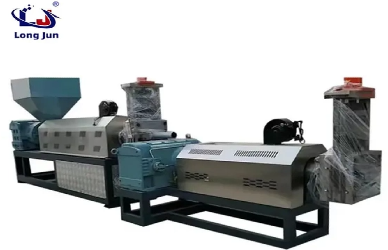
Plastic recycling involves several machine types, each serving a specific function in processing waste plastic. Below is a detailed description of the most commonly used machines in the recycling process:
Function: Shredders are designed to break down large plastic items into smaller, more manageable pieces. The process involves using powerful blades to cut through plastic materials, making them easier to handle and process in subsequent stages.
Uses: Shredders are ideal for dealing with bulky plastic waste such as containers, bottles, and plastic sheets. The small, uniform pieces created by the shredder are easier to store, transport, and process further, whether for cleaning, melting, or extrusion.
Advantages: Shredders are efficient in size reduction and help prepare plastic waste for more precise recycling steps. They can handle a wide variety of plastic materials, making them versatile in industrial settings.
Function: Extruders melt shredded plastic and push it through a mold to form continuous shapes, such as sheets, pipes, or filaments. The extruder helps reshape the plastic into usable forms that are uniform and suitable for further production.
Uses: Extruders are used to create a range of products, from plastic pipes to flat sheets, by forcing the melted plastic through specific molds or dies. They are essential for transforming waste plastic into a more usable form for manufacturing new plastic products.
Advantages: Extrusion is a continuous process that allows for efficient processing of large volumes of plastic waste. It provides a high level of control over the shape and quality of the recycled product.
Function: Pelletizers take the melted plastic from the extruder and cut it into small, uniform pellets. These pellets are easier to handle and store, and they can be used directly in manufacturing new products through injection molding or extrusion.
Uses: Pelletizers are essential in the final stage of recycling, as they produce small, consistent pellets that can be easily transported and melted again for the production of new plastic items.
Advantages: The pellets created by pelletizers are uniform in size, making them suitable for efficient processing in various manufacturing applications. They help improve the consistency of recycled plastic products.
Function: Granulators are machines that grind plastic into smaller particles or flakes. Unlike shredders, which break down plastic into larger pieces, granulators focus on creating fine particles that are easier to melt and reprocess.
Uses: Granulators are used to process plastic waste into fine particles that can then be melted and formed into new products. They are often used in pre-processing stages to prepare plastic for extrusion or other recycling steps.
Advantages: Granulators produce a finer, more consistent particle size, which is ideal for processes that require precise melting and molding of the recycled plastic.
Function: Compactors are machines that compress plastic waste into dense, tightly packed bales. This reduces the volume of plastic and makes it more efficient to store and transport before it undergoes further processing.
Uses: Compactors are primarily used to handle large amounts of plastic waste, reducing its volume and preparing it for efficient recycling. They are especially useful for industries that generate large volumes of plastic materials.
Advantages: By reducing the volume of plastic, compactors help save storage space and reduce transportation costs, which is especially important for large-scale recycling operations.
Machine Type | Purpose | Common Uses | Capacity/Output | Key Features |
Shredders | Size reduction | Breaking down large plastic items | High-volume waste processing | Robust, high throughput |
Extruders | Melting and shaping | Creating uniform plastic sheets, pipes | Continuous processing | High temperature control |
Pelletizers | Cutting into uniform pellets | Producing plastic pellets for reuse | Variable depending on size | Precision pellet formation |
Granulators | Grinding into small particles | Preparing plastic for reprocessing | High-speed particle production | Fine, consistent output |
Compactors | Reducing volume of plastics | Preparing plastics for recycling | Compacting large volumes | Space-saving, cost-efficient |
This table offers a quick comparison of the various plastic recycling machines, highlighting their purpose, typical uses, capacity, and key features. Each machine serves a unique role in the recycling process, contributing to the overall efficiency of plastic waste management and recycling in industrial applications.
When selecting the ideal plastic recycling machine, it's important to consider several factors to ensure efficiency, cost-effectiveness, and long-term durability.
Capacity: Ensure the machine can handle your waste volume effectively, matching your production needs.
Output: The machine should deliver consistent, high-quality recycled plastic for reuse.
Efficiency: Choose machines that offer fast processing speeds and high material throughput to maximize productivity.
Energy Consumption: Opt for machines that minimize energy use while maintaining performance. Energy-efficient machines help reduce operating costs.
Environmental Impact: Select machines that reduce emissions and environmental footprint, contributing to sustainability in the recycling process.
Maintenance: Choose machines that are easy to maintain and service, reducing downtime and repair costs.
Durability: A durable machine ensures reliable, long-term operation. Look for machines built with high-quality materials for continuous use.
Shredders are designed to break down large plastic items into manageable pieces, while granulators are used for grinding plastic into finer particles.
Extruders are suitable for processing a wide range of plastics, including PET, HDPE, and PVC, to create uniform products like sheets, pipes, and pellets.
Energy-efficient machines reduce operating costs and minimize environmental impact, making them more sustainable for long-term use.
Yes, many modern machines are capable of processing a variety of plastics, though some may be specialized for certain materials based on the machine's design.
Selecting the right plastic recycling machine is crucial for businesses aiming to efficiently manage plastic waste and contribute to sustainability. Each machine type—whether it’s a shredder for size reduction, an extruder for shaping, a pelletizer for creating uniform pellets, a granulator for grinding, or a compactor for volume reduction—serves a unique role in the recycling process. The suitability of each machine depends on the specific needs of the business, including the types and volumes of plastic waste generated and the desired end product. Businesses should carefully evaluate their requirements, such as processing capacity, energy efficiency, and machine durability, to ensure they invest in equipment that maximizes efficiency and minimizes long-term costs. By making an informed decision, companies can optimize their recycling processes, reduce environmental impact, and support sustainable manufacturing practices.


